Tag Archive | history

The History of Yule

The Winter Solstice
By SpringWolf, D.D., Ph.D.

The Winter Solstice marks the shortest day of the year and the beginning of Winter. In simple terms it is one of two points on the ecliptic at which the sun is overhead at the tropic of Capricorn, when the Sun is at its southern most point for those in the Northern Hemisphere.

“The earliest people on Earth knew that the sun’s path across the sky, the length of daylight, and the location of the sunrise and sunset all shifted in a regular way throughout the year. They built monuments such as Stonehenge in England and Machu Picchu in Peru to follow the sun’s yearly progress.”
Deborah Byrd

The Winter Solstice has marked the beginning of winter and provided a point in time where homes and communities needed to be prepared and ready for the barren cold months. For some it designated the official end of the harvest season. For others it marks a time of spiritual celebration. And for others it’s nothing more than an astronomical occurrence and scientific event. But to Pagans, it marks the beginning of the 12 Days of Yule and time to honor the Triple Goddess and rebirth of the God. Continue reading
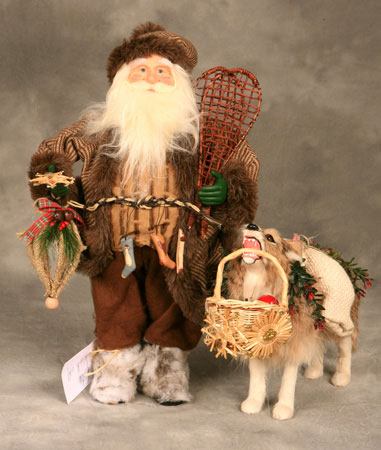
Sunday Homily: Who is Santa Claus – A History

Happy Holiday Howling!

Happy Holiday Howling!

The Origins Of The Winter Gift Giver
By SpringWolf, D.D., Ph.D.

It twas a blustery night as the snow fell heavily through the wintry barren trees. The land lay quiet, the fields are still from harvest and inside the hearth blazed warm with the burning yule log. But overhead in the storm laden clouds, a clash of hooves and metal thunder in the night. For Odin and his great horse Sleipnir are celebrating the Wild Hunt on this solstice eve with spear in hand and brethren by his side. Their windswept ride is long and filled with madness that shall not end till the twelfth night of Yule. But during their ride, in the fields below, there lies grain of plenty and piles of straw fit for the hordes of Odin’s steeds. His eight legged horse Sleipnir rests upon the ground and feasts on the meal left for the mounts of the Gods. And in return for this gift, Odin the All-Father leaves presents of gold. Quietly he fills the winter boots resting outside the door of the humble homes that lay quiet in the cold winter night. Continue reading

The History Of Samhain And Evolution of Halloween

 Photograph by Mukul Soman

Photograph by Mukul Soman
National Geographic

Samhain – The Celtic New Year
Whether you use the Gaelic pronunciation “Sow-en”, “Sow-ween”, “Sah-ween” or the Americanized version “Sam-hain” (yes that is an acceptable pronunciation), it’s still the biggest holiday on the Pagan Calendar.

It’s the start of the Celtic New Year and honors the year that has passed. It is the time when the veil of forgetfulness is lifted between the physical world and the spiritual world. Where the dead are honored and communication with spirit can take place more than any other time of the year.

For pagans it’s a time of celebration, but it’s also a time of reverence and deep spiritual reflection for the past and the future year to come.

An article by the Library of Congress states: Pagans divided the year by four major holidays. According to their calendar, the year began on a day corresponding to November 1st on our present calendar. The date marked the beginning of winter. Since they were pastoral people, it was a time when cattle and sheep had to be moved to closer pastures and all livestock had to be secured for the winter months. Crops were harvested and stored. The date marked both an ending and a beginning in an eternal cycle. Continue reading

Religious Awareness In America

Patriotic Wolf - Artist UnknownThe Importance of Secular Government

Secular:
of or pertaining to worldly things or to things that are not regarded as religious, spiritual, or sacred; temporal: secular interests.

There’s a lot of talk in the U.S. today about the founding fathers establishing our constitution based on Christian values and therefore America is a Christian Nation. Unfortunately this propaganda by religious zealots is false and not only breeds intolerance, it misrepresents the intent of the founding fathers or attempts to re-write American History.

I believe it’s important for all people to speak up and correct these misconceptions if our nation or any nation is to remain free. Many have given the ultimate price to ensure those freedoms and if their sacrifice is to remain meaningful, everyone must ensure the attempt to change history does not succeed.

Through some research I happened upon the following article that can explain the historical position of many of the founding fathers and their predecessors. Thanks to the author for allowing me to reprint their ever so well written article here. For more reading, check the resources provided by Mr. Walker at the end of this article.

A few definitions to help up front:

  • Deism:
    belief in the existence of a God on the evidence of reason and nature only, with rejection of supernatural revelation ( distinguished from theism).
  • Atheism:
    the doctrine or belief that there is no God, disbelief in the existence of a supreme being or beings.

Little-Known U.S. Document Signed by President Adams Proclaims
America’s Government Is Secular
by Jim Walker
earlyamerica.com

Some people today assert that the United States government came from Christian foundations. They argue that our political system represents a Christian ideal form of government and that Jefferson, Madison, et al, had simply expressed Christian values while framing the Constitution. If this proved true, then we should have a wealth of evidence to support it, yet just the opposite proves the case. Continue reading

History Of Lughnasadh

The Fire Festival Of The Summer Sun
By Springwolf, D.D., Ph.D.  🐾

Arctic Wolf Fire

“Arctic Wolf Fire”
© Tom-in-Silence

This is the first of the Pagan Harvest Festivals. This is a time where we celebrate the Sun God Lugh, honor the rain and thank the magikal folk of the Tuatha Dé Danann for their help in our own gardens.

As local clans migrated, they took with them their religious and spiritual traditions. Many people believe that during these migrations, names of holidays also changed and Lughnasadh became Lammas. That’s not quite accurate however.

Lammas comes from the Old English word hlafmæsse, which  literally means “loaf mass,”. It was first used in the 15th and 17th centuries by the early Catholic Churches to celebrate the grain provided by the first harvest. In other words, it was another attempt by the early church to co-opt a pagan holiday, make it their own, in order to convert pagans.

Many Anglo-Saxon pagan clans, adopted the name, but still observed the original celebrations of Lugh and the original intent of the holiday. Must pagan purests prefer to ignore the Christianized version of the festival and stick with the early Celtic name of Lughnasadh. As with most things in the world of spirituality, your preferred name should ring true with you. It’s your festival to honor the Sun, the warmth of the summer and their blessings upon the fields. Call it what you feel most connected to, Lughnasadh or Lammas.
Continue reading

Celebrating the Summer Solstice

The Mid-Summer Festival
By Springwolf, D.D., Ph.D.  🐾

The Summer Solstice is a pre-Christian holiday and has been celebrated throughout Europe and many parts of the world for eons. The solstice itself has remained a special moment of the annual cycle of the year since Neolithic times.

In Anglo-Saxon form, the holiday is known as Litha. A Germanic word for June and meaning mid-summer. In Irish form Meitheam. (From Old Irish mithem (“midsummer, June”), from Proto-Celtic *medjo-samīno- (compare Welsh Mehefin)).

Today Solstice celebrations center around the astronomical timing of the summer solstice. But many pagans still hold to traditional lunar calendar celebrations holding the rite at sunset on June 20th, the 21st or June 24, the day of the solstice in Roman times.

Like most pagan holidays, the early Christian Church assimilated the holiday into their calendar and original Celtic celebrations slowly faded. The “new” holiday is associated with the nativity of John the Baptist, which is observed on, June 24. Knowing that pagans followed a lunar calendar and began their celebrations at sunset on the eve before the Gregorian calendar date, the early church established St John’s Eve on the evening of June 23. This is the eve of celebration before the Feast Day of St John the Baptist. Continue reading

The History of Friday The 13th – A Good Day For Pagans

Friday the 13th“Black Friday” or “Black Cat Day”

Fear of Friday the 13th is known as triskaidekaphobes.

When fear of the day started is up for debate. Some suggest little can be found about the day being negative or filled with bad luck prior to the late 1800s. But others link the phobia to older historical events and occurrences which symbolize the link between the number thirteen and Friday to disastrous events.

One thing many seem to agree to is that both the number thirteen and the sixth day of the week (Friday) have been associated with negative connotations from patriarchal societies and most definitely western cultures. Where as matriarchal societies associate both these objects with positive aspects and connotations.

Pagans Honor The 13th
We should begin with a short explanation for the layman about who and what are Pagans.

By academic definition, Pagans are any religion or spiritual path that does not follow Abrahamic doctrine. It’s a category of religions that would include Buddhism, Hinduism, Shamanism and Pagan Metaphysics (Witchcraft). It’s these last two that are largely associated with modern Paganism. Continue reading